

.avif)
Imagine a marketing team that runs 75 events a year. Now think of them adding 12 more events to their program with no budget expansion and no new hires. Someone must have had to pay for that: late nights, weekends sacrificed, and a team that must be running on a mixture of adrenaline and exhaustion. They must be doing 16-hour days, right?
That would be the case normally. But let's say this team made one structural decision with their event platform that made scaling possible without any of the stress. What if, by taking this road, they've started on a path of compounding benefits that will keep paying off for years to come?
You'd call that unreal and a lot of fluff. But maybe it isn’t.
Why having one database and one context layer matters for your event strategy (and your career)
Scaling is additive: Put three more field events on the calendar, hire a coordinator, push the overflow to an agency. The program grows in size but the way it works doesn't change.
You can have more landing pages, but only you know what worked last time and what variants to cut. You know which session format drove re-registrations in Boston, which speaker pairing fell flat in London, which email subject line doubled open rates for the dinner series. That context is in your head, or split across your production lead, your ops counterpart, and the two field marketers who ran the regional programs. When any one of you goes on leave, that slice of the program's memory goes too.
Every event is configured manually from a template. The brand guidelines, the email sequences, the registration logic, the approval flows are duplicated per event, sometimes per tool. A second coordinator doesn't change this.
And you're the connective tissue. You're chasing the designer, waiting on marketing ops to build the campaign and schedule the send, waiting on the VP of sales to approve a guest list, looping in every vendor and customer contact one at a time. A second coordinator can chase more sign-offs, but the relationships and the history are yours. The platform can't coordinate on your behalf.

The reason for this is structural. When you're using separate tools for webinars, registration, lead capture, and your flagship conference, the tools have no way to share memory. The brand guidelines your design team configured in one doesn't carry to the next. What one tool's AI learns about registration patterns is invisible to the others. That's why you remain the connective tissue.
The good news is, marketing already knows how to do compound programs in other channels. Think of an org that’s been using and updating their CRM since day 1. They have years of account history, deal patterns, and buyer signals. So when AI arrived, they could point it at a decade of pipeline data and reap the benefits of pattern analysis and predictions without a lot of legwork.
That's what a compounding event platform does. Define your guardrails and configurations once at the program level and they're inherited by every event. The platform learns your event playbook.
By event 87, the platform is drawing on years of data and decisions: which content format drove re-registration, which accounts sent three attendees and never received a follow-up, which cities produce pipeline within 30 days versus 90.
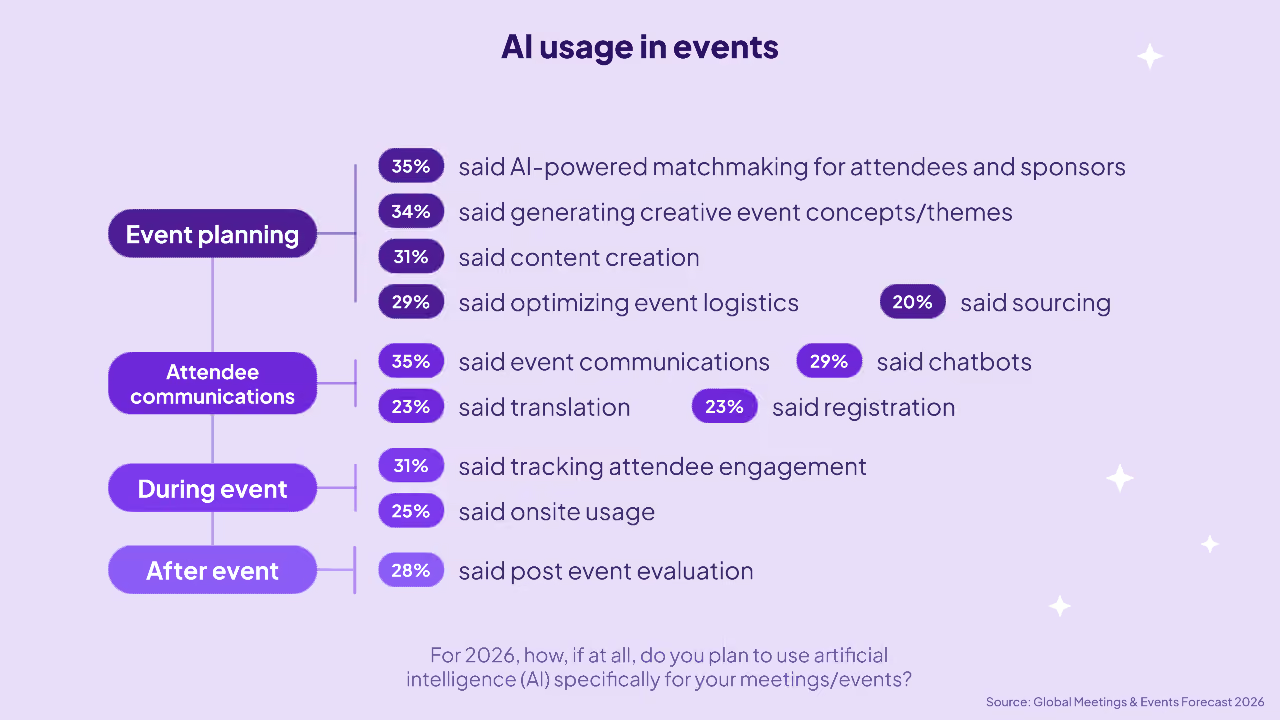
For events specifically, 50% of event teams are already using AI across planning and delivery. But most of these use cases are siloed: drafting session descriptions, writing follow-up emails and generating copy.
The shift from that to AI as a co-operator of events with things like creating an event from a prompt, a QA agent scanning the full setup before launch, a follow-up agent tracking per-rep outreach and escalating when the SLA slips, is only possible on a platform where AI has the full context of the program to reason from.
And when nominations, tiered approvals, and follow-up dashboards live inside the platform, where sales, marketing, and CS work the same rows with CRM context attached, the event marketer stops being the routing layer between departments. Sales can trigger a customer dinner without filing a ticket. The coordination moves from Slack threads and spreadsheets into a collaborative space the whole team can see and act on directly
The event marketer role in two years: what the event marketing strategy shifts toward
AI has already had an effect on marketing headcounts. People are expected to be ‘10x marketers’ and events are no exception. Most are trying to meet that expectation on infrastructure built for a simpler version of the role. But that often means they don't have any runway to do anything except the next event, leading many event marketers to look for a change.
AI-nativity is starting to become table stakes in many roles. AI-specific roles are growing 8x faster than the wider market and marketing is increasingly becoming more of a systems function.
And it's not just workload. Leadership expectations have shifted. Boards are mandating AI-native vendors.
A unified, agentic platform makes the event marketing role a bit more future-proof. The platform carries the context, operates the events, and coordinates the execution. What's left for the event marketer is judgment: which accounts to target, which formats to run in which cities, which signals from last quarter should change this quarter's plan.

As agentic platforms become the norm, the connection between an event and a closed deal stops being something you reconstruct weeks later. Pipeline attribution becomes visible at the program level without a separate analytics build. Events become an even more integrated part of the revenue motion.
And every event in the program — the 40-person dinner, the regional roadshow, the monthly webinar — gets the same brand consistency, personalization, and operational polish as the annual conference. Execution quality stops being a function of which event got the largest budget.
The event marketer's role shifts from production to orchestrating the program and ensuring guardrails. The teams who move onto this infrastructure now are compounding their own skillset alongside their events strategy.
Pull up your last event and see what your platform remembers about it without being manually fed information. If the answer is 'not much', you might need to consider a platform that can take the context, execution and coordination burden off your plate.
Take a look at how Zuddl helps build and compound your company’s institutional knowledge of events.
{{demo-widget-1}}

Subscribe to our blog now!

.png)
.avif)


